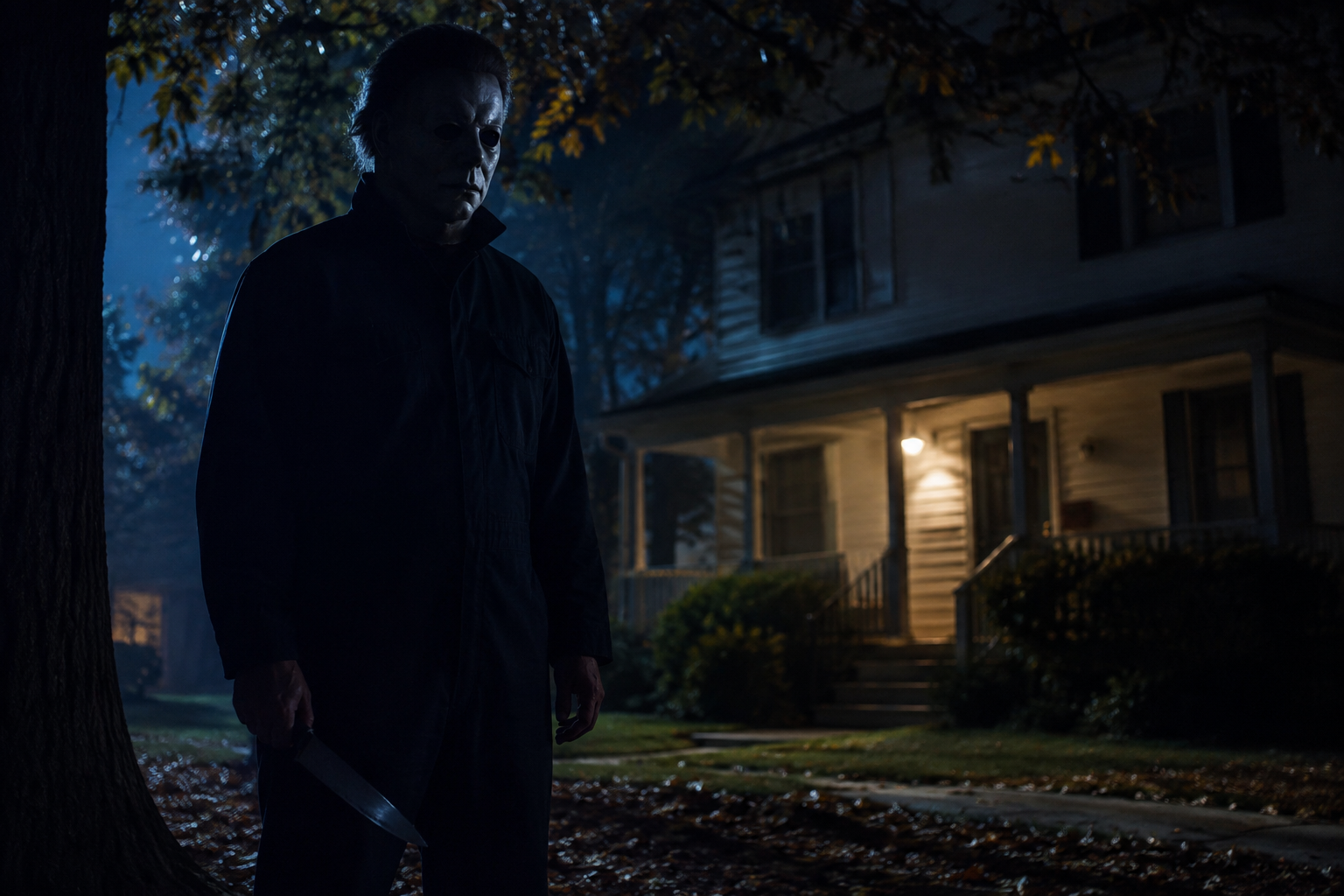
A cheap mask. A babysitter. A guy who apparently never learned how to hurry. Somehow, John Carpenter turned that into one of the scariest movies ever made.
Spoilers ahead. Look, Halloween came out in 1978. At some point the statute of limitations has to kick in.
Before Michael Myers had a pile of sequels, alternate timelines, family revelations, cults, reboots, remakes, and enough continuity problems to require a flowchart, he was something much simpler.
He was a guy standing across the street.
And somehow, that was worse.
John Carpenter’s original Halloween runs 91 minutes, was released on October 25, 1978, and credits Carpenter as director, co-writer, and composer. Debra Hill co-wrote and produced it. [1] The movie was made for about $300,000 and shot in just 21 days in the spring of 1978, mostly around South Pasadena, California. [2]
Nearly everything about the movie is simple.
That’s exactly why it works.
The Story Is Barely a Story — And That’s a Compliment
Halloween opens in 1963 with one of the great horror movie introductions.
We creep toward a suburban house from a killer’s point of view.
We go inside.
We grab a knife.
A teenage girl is murdered upstairs.
Then we get the reveal.
The killer is six-year-old Michael Myers.
Fifteen years later, Michael escapes from Smith’s Grove Sanitarium and heads home to Haddonfield, Illinois, with his psychiatrist Dr. Sam Loomis desperately trying to get somebody — anybody — to understand that letting Michael wander around unsupervised on Halloween night might be a fairly serious problem.
Meanwhile, high school student Laurie Strode is going about her day.
She sees a strange man standing near her school.
Then outside a house.
Then behind some laundry.
Then he’s gone.
That’s basically the magic trick.
Michael doesn’t charge at Laurie with a machete while heavy metal blasts on the soundtrack. He doesn’t jump through a window every six minutes.
He just appears.
Carpenter spends a huge chunk of the movie making you wonder whether Michael is somewhere in the frame.
And after a while, you’re checking even when he isn’t.
Michael Myers Was Scarier Before We Knew Everything About Him
If you grew up on the later Halloween movies, going back to the original can feel almost strange.
There isn’t much mythology here.
Michael isn’t giving speeches. Nobody explains his supernatural power level. There isn’t a ten-minute flashback telling us what happened to him in elementary school.
He is deliberately empty.
Nick Castle — Carpenter’s friend from film school — played the masked Michael for much of the movie and was credited simply as The Shape. The production history makes it clear just how stripped-down the character was intended to be. [2]
That name tells you almost everything you need to know.
Michael isn’t supposed to be some fascinating personality.
He moves.
He watches.
He kills.
That’s about it.
And that blankness leaves the audience with nowhere comfortable to go.
Dr. Loomis fills in the rest.
Donald Pleasence plays Loomis like a man who has spent fifteen years staring into a hole and is extremely tired of people telling him it’s probably fine.
He’s dramatic as hell, sure.
But Pleasence completely sells it.
When Loomis talks about Michael, he isn’t describing a damaged patient anymore.
He’s describing evil wearing work boots.
And Yes, Michael Myers Is Wearing Captain Kirk’s Face
One of horror’s most famous faces came from an incredibly expensive special-effects department known as a costume shop.
Production designer Tommy Lee Wallace bought a Captain Kirk mask for $1.98, widened the eye holes, and spray-painted the face a pale bluish white. [2]
The idea was to create something almost featureless.
It worked a little too well.
Once the familiar William Shatner features disappeared underneath the paint, the mask became something else completely.
Those black eye holes are probably the most important part.
You can’t read Michael’s expression.
You can’t tell whether he’s angry.
You can’t tell whether he’s excited.
Half the time you can’t even tell whether he’s looking directly at someone.
He’s just there.
The fact that one of the most recognizable monsters in movie history was basically created with two bucks, some paint, and a little creative destruction is exactly the kind of thing that makes low-budget horror great.
The Camera Is Doing Most of the Scaring
A huge reason Halloween still works is cinematographer Dean Cundey. Carpenter and Cundey shoot Haddonfield in widescreen, giving Michael plenty of room to hide. The official production history also notes the use of the Panaglide camera-stabilization system for the movie’s unnervingly smooth movement. [2]
Way over there.
Behind Laurie.
Near a hedge.
At the edge of the frame.
Standing perfectly still while your brain suddenly screams:
WAIT, WAS THAT GUY THERE BEFORE?
Even during the daytime, the movie isn’t comfortable.
That’s important.
Some of Halloween’s creepiest scenes happen under bright blue skies while kids are walking home from school.
Michael doesn’t need darkness.
He can stand twenty feet away from you at 2:30 in the afternoon and somehow make an entire neighborhood feel wrong.
Then That Music Starts

Dun-dun-dun-dun-dun…
You already heard it in your head.
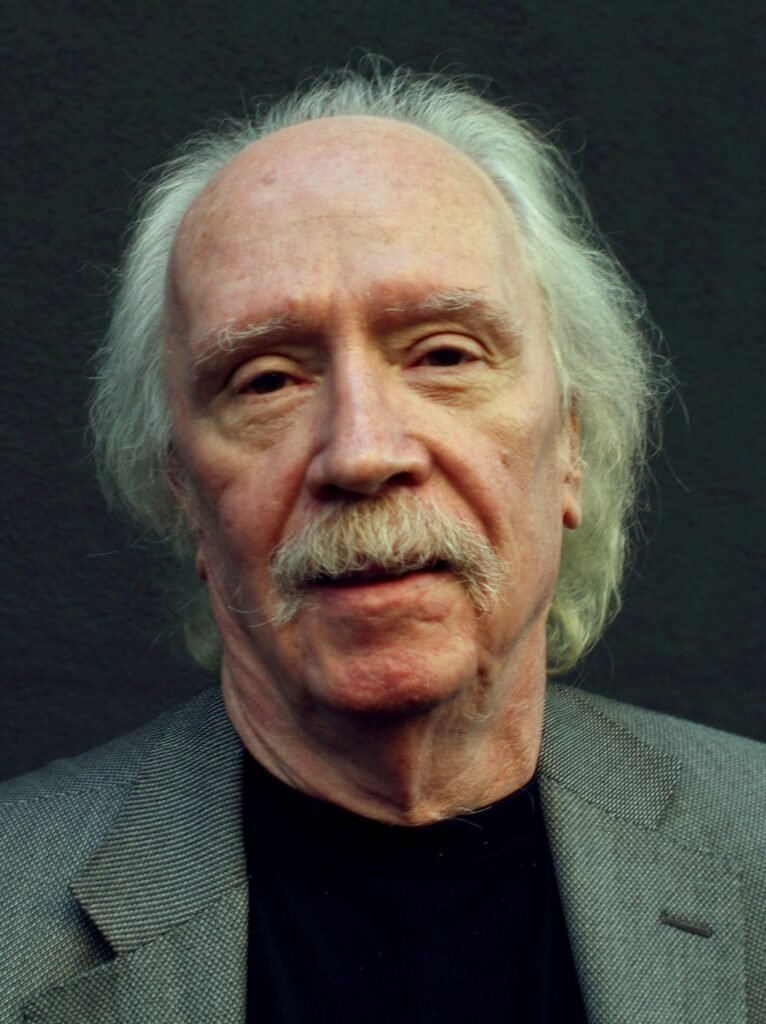
Carpenter composed and performed the score, and the original soundtrack opens with “Halloween Theme — Main Title.” [5]
It’s ridiculously effective.
The music doesn’t just tell you Michael is coming.
Sometimes it makes you think he’s coming.
That’s worse.
A modern horror movie might throw fifty different sounds into a scare.
Carpenter can basically hit a few notes on a keyboard and suddenly you don’t trust your hallway anymore.
Efficiency.
Jamie Lee Curtis Didn’t Need Much Time to Become a Horror Icon

_(cropped).jpg)
Jamie Lee Curtis was 19 when she played Laurie Strode. Carpenter’s production history says Debra Hill immediately understood the publicity value of casting Janet Leigh’s daughter — Leigh, of course, being the star of Psycho. [2]
That’s a pretty good horror bloodline.
Laurie could easily have been a boring character.
She’s the responsible one. She babysits. She does homework. Her friends tease her.
But Curtis makes her feel like an actual teenager instead of a future victim waiting for the screenplay to catch up with her.
And once things go bad, Laurie fights.
She runs.
She hides.
She stabs Michael with a knitting needle.
She uses a coat hanger.
She grabs his own knife.
She also makes the classic horror-movie mistake of deciding Michael must definitely be dead without performing anything resembling a medical examination.
Twice.
We’ll forgive her.
It was 1978.
The rules hadn’t been written yet.
They Shot Illinois in California — In the Spring

Here’s where the roughly $300,000 budget becomes even more impressive.
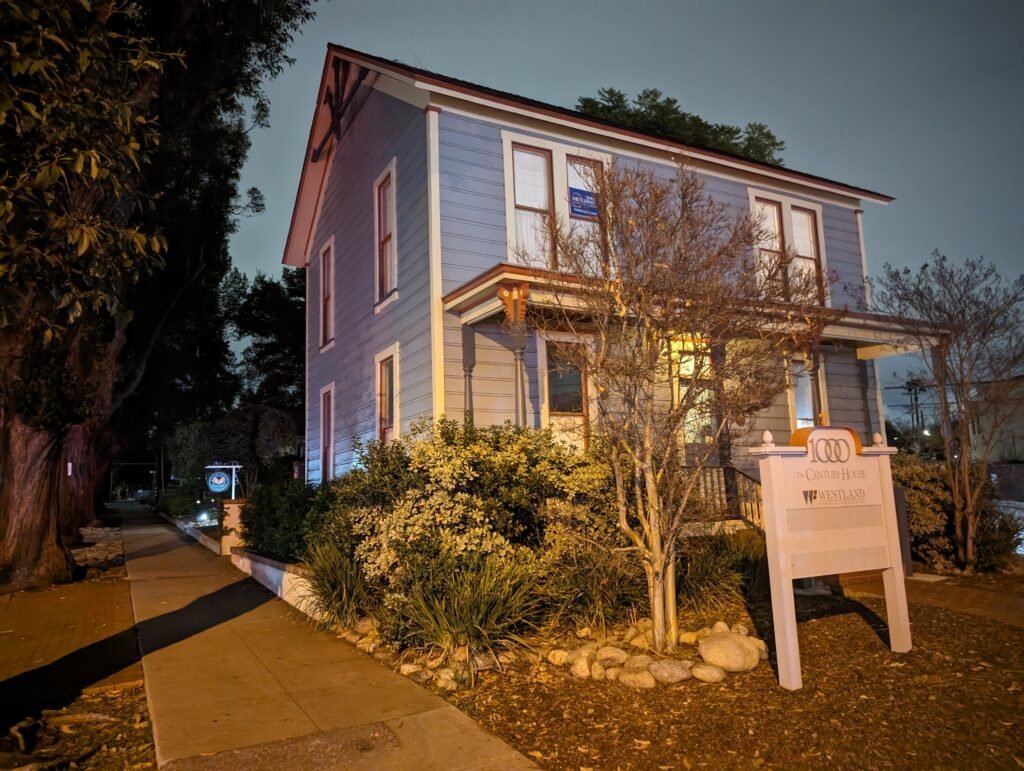
Halloween was shot in just 21 days during the spring of 1978, mostly around South Pasadena. [2]
Which creates a slight problem when your movie is supposed to take place in Illinois on October 31.
Palm trees don’t exactly scream Midwest autumn.
Neither does Southern California sunshine.
The crew had to fake the season, right down to hauling around autumn leaves and reusing them from shot to shot. [2]
Once you know all this, watching Halloween becomes a fun little game of Spot the Palm Tree.
But here’s the amazing part:
It barely matters.
The movie feels like Halloween.
Carpenter creates the season through pumpkins, kids in costumes, shadows, neighborhood streets, dead leaves, decorations, and music.
Your brain fills in the rest.
The Kills Are Surprisingly Tame
People who know Michael Myers mainly from later sequels may be surprised by how restrained the original movie is.
Halloween isn’t particularly interested in gore.
That restraint is one of the things the Library of Congress highlights when discussing the movie’s importance: the film creates tension with comparatively little blood, leaning instead on point-of-view photography, editing, and Carpenter’s score. [3]
Annie’s death isn’t memorable because we get a five-minute anatomical demonstration.
Bob’s death isn’t memorable because thirty gallons of blood hit the wall.
They’re memorable because Michael has been lurking around these people for what feels like forever.
By the time he finally attacks, Carpenter has already done most of the work.
No, Halloween Didn’t Invent the Slasher Movie
Horror history gets messy when people start declaring that one particular movie “invented” an entire genre.
Psycho existed.
Peeping Tom existed.
The Texas Chain Saw Massacre existed.
And Bob Clark’s Black Christmas was stalking young women from a killer’s point of view four years before Michael Myers came home.
The BFI specifically points to Black Christmas as an earlier holiday-based slasher while crediting Carpenter’s movie with making Halloween itself a lasting fixture of the form. [4]
What Halloween did was put a bunch of ingredients together so effectively that filmmakers could copy the recipe.
The quiet neighborhood.
The teenage victims.
The holiday setting.
The masked killer.
The stalking POV.
The escalating body count.
The surviving heroine.
The killer who maybe isn’t quite as dead as everyone would really, really like him to be.
Then came the flood.
Friday the 13th.
My Bloody Valentine.
The Burning.
And about nine billion other movies where a group of teenagers apparently never realized that splitting up was a terrible idea.
Halloween didn’t invent every piece of the slasher movie.
It just put the pieces together so effectively that everybody noticed.
$300,000 In. Horror History Out.
The financial side of Halloween is almost as ridiculous as the Captain Kirk mask.
The movie cost around $300,000. [2] Whatever number you use to measure its later commercial life, the important part is that a tiny independent production turned into a horror institution.
Michael Myers became one of the faces of horror.
Jamie Lee Curtis became one of the genre’s defining stars.
Carpenter became Carpenter.
And filmmakers spent decades trying to figure out how to recreate what those people had pulled off with a tiny budget, some fake leaves, and William Shatner’s face.
In 2006, Halloween was added to the Library of Congress’s National Film Registry. [3]
Not bad for a babysitter movie.
Does Halloween Still Hold Up?
Absolutely.
But probably not for the reason somebody coming to it for the first time expects.
It’s not especially brutal by modern standards.
It’s not fast.
There are long stretches where technically not much happens.
Teenagers walk around.
Laurie babysits.
Loomis stands outside a house.
Michael drives around town despite the interesting unanswered question of who taught Michael Myers how to drive.
And that’s the movie.
The waiting is the horror.
Carpenter understands something that a lot of louder horror movies forget:
Seeing the monster can be scary.
Thinking you might have seen the monster is scarier.
Michael Myers doesn’t need to sprint after Laurie.
He doesn’t even need to move.
Sometimes all he has to do is stand at the other end of the street.
And nearly 50 years later, we’re still staring back.
MurderFan Verdict
🎃 Essential horror.
If you’re remotely interested in slashers, Michael Myers, John Carpenter, or just how much terror filmmakers can squeeze out of almost no money, Halloween is required viewing.
Scariest thing: Michael silently appearing in the background.
Best weapon: The camera.
Most impressive special effect: Turning Captain Kirk into pure evil for $1.98.
Biggest mystery: Seriously, who taught Michael how to drive?
Sources & Media Credits
- The Official John Carpenter — Halloween. Film credits, release date, runtime, and official trailer.
- HalloweenMovies — Halloween Behind the Scenes. Production budget, 21-day shoot, South Pasadena locations, mask construction, seasonal production tricks, and other production history.
- Library of Congress — National Film Registry descriptions and essays. Registry status and discussion of the film’s slasher influence, restraint, POV photography, editing, and score.
- BFI — 10 great autumnal horror films. Context for Black Christmas and Halloween in the development of holiday slashers.
- The Official John Carpenter — Halloween Soundtrack and Apple Music — “Halloween Theme — Main Title”.
- Halloween House photo — Jeremy Thompson / Wikimedia Commons, licensed CC BY 2.0.
- John Carpenter photo — Nathan Hartley Maas / Wikimedia Commons, licensed CC BY-SA 3.0.
- Jamie Lee Curtis photo — Gage Skidmore / Wikimedia Commons, licensed CC BY-SA 2.0.
Media note: The article package does not copy copyrighted film stills, poster art, trailer video, or soundtrack audio. The three packaged photographs are reusable under the licenses credited above. Trailer and music are embedded from their official/authorized hosts.
Leave a Reply